

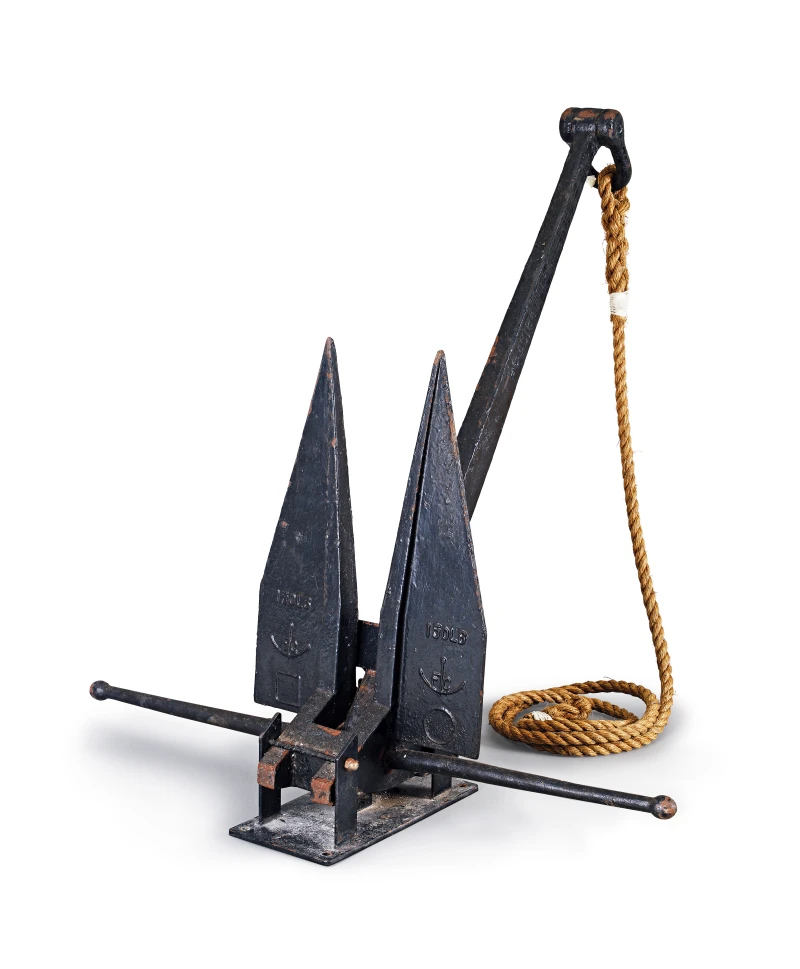
1987-061
Anchors are heavy objects attached to boats by chains, which are lowered into the water. Their flukes penetrate the seabed and hold vessels in place to prevent them from drifting with the wind or current. This anchor was used on RSS Sovereignty, an Independence-class patrol craft (PC) ordered from shipbuilder Vosper Thornycroft in 1968. RSS Sovereignty was one of the first ships acquired by the Republic of Singapore Navy following Singapore’s independence in 1965. The PCs were acquired to allow the fledgling Navy to carry out more effective patrols to prevent and deter smuggling, robberies, and illegal migration in Singapore’s waters. As RSS Sovereignty was an 110-foot patrol craft capable of travelling up to 30 knots, important considerations had to be made on the appropriate type of anchor. Although all anchors serve the same basic function of slowing and mooring ships at sea, various factors such as ease of storage and holding power-to-weight ratio impact their design. The Danforth anchor, invented in 1939 by American civil engineer Richard Danforth, was eventually chosen. These mooring devices were widely used during World War II by transport vessels in operations such as the Normandy landings on 6 June 1944. This anchor is also a popular choice for smaller boats, as it is relatively light but contains considerable holding power of up to 14.2 times its own weight. Its teeth-like triangular flukes are angled downwards so that as more drag or resistance is exerted while moving, the angled design will force the flukes further downwards into the seabed. The Danforth anchor is also favoured as it can be laid flat on the ship’s deck for easier storage. Although RSS Sovereignty has been decommissioned, Danforth anchors remain in use today by many ships around the world.
View object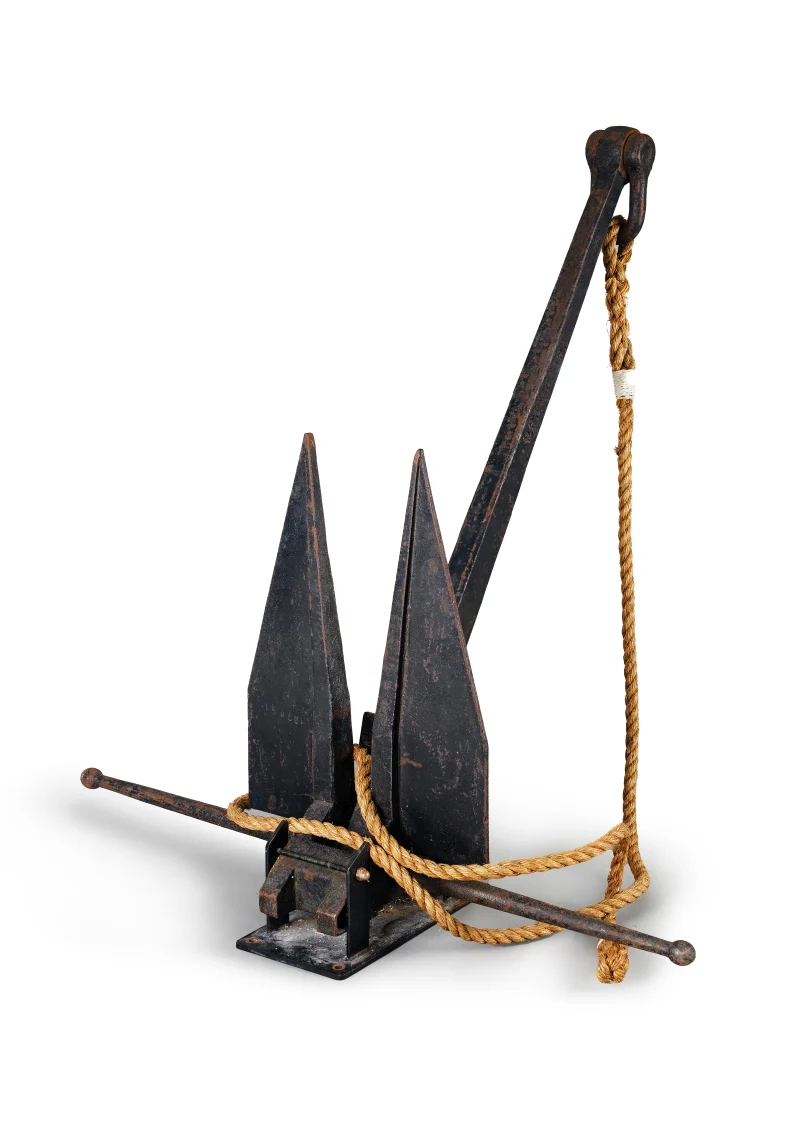
1987-060
Anchors are heavy objects attached to ships and boats by chains, which are lowered into the water. Their flukes penetrate the seabed, holding vessels in place and preventing them from drifting with the wind or current. This anchor was used on RSS Independence, an Independence-class patrol craft (PC) ordered from shipbuilder Vosper Thornycroft in 1968. This ship was one of the first acquired by the Republic of Singapore Navy following Singapore’s independence in 1965. The PCs were acquired to allow the fledgling Navy to perform more effective patrols to prevent and deter smuggling, robberies, and illegal migration in Singapore’s waters. As RSS Independence was an 110-foot patrol craft able at a speed of up to 30 knots, important considerations had to be made on the appropriate type of anchor. Although all anchors serve the same basic function of slowing and mooring ships at sea, various factors such as ease of storage and holding power-to-weight ratio impact their design. The Danforth anchor, invented in 1939 by American civil engineer Richard Danforth, was eventually chosen. These mooring devices were widely used during World War II by transport vessels in operations such as the Normandy landings on 6 June 1944. This anchor is also a popular choice for smaller boats, as it is relatively light but contains considerable holding power of up to 14.2 times its own weight. Its teeth-like triangular flukes are angled downwards so that as more drag or resistance is exerted while moving, the angled design will force the flukes further downwards into the seabed. The Danforth anchor is also favoured as it can be laid flat on the ship’s deck for easier storage. Although RSS Independence has been decommissioned, Danforth anchors remain in use today by many ships around the world.
View object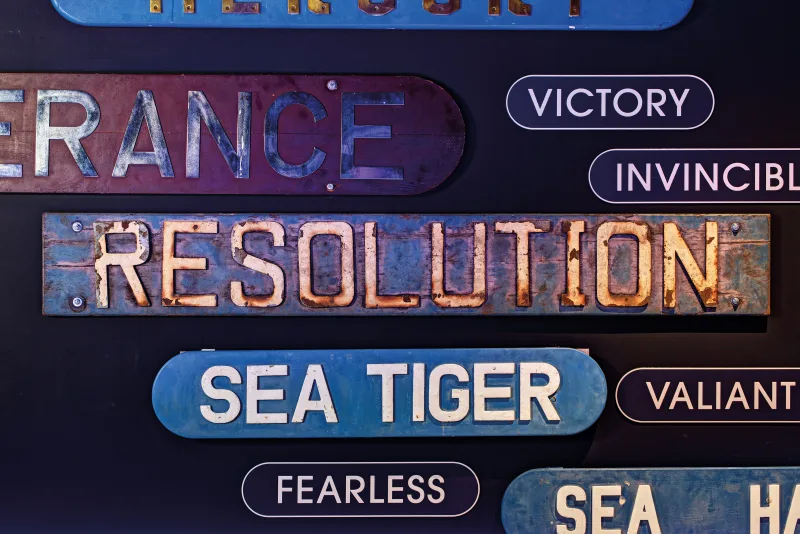
2012-004
Ship naming is a long-standing maritime tradition dating back many centuries. According to nautical traditions, a ship’s name is not only an indicator of identity, but it is also said to play an important role in ensuring good fortune and safety to the vessel and her crew. A ship’s name is officially unveiled to invited guests during a ship launching ceremony to celebrate the transfer of a ship from land to water for the first time. While the names of civilian vessels are often up to the owners, the convention for naming military vessels differs from country to country. During a ship launching ceremony, a sponsor will typically christen the ship by smashing a bottle of champagne or other types of alcoholic beverages against her bow. This is believed to bring good luck to the vessel and ensure her safe passage. It is considered bad luck if the bottle fails to break. The sponsor is usually a person of importance, such as the ship’s builder, owner, or a dignitary. Although it is customary for sponsors to be female, there is no hard and fast rule that forbids men from participating in ship christening ceremonies or performing the tradition of breaking the bottle. Women are often chosen as sponsors because they are seen as symbols of good luck. It is hoped that nurturing and protective qualities, which are traditionally associated with women, will help to ensure the ship’s safety and success. In modern times, the choice of sponsor may vary depending on the ship, the cultural context, as well as the preference of those involved in decision-making. This nameboard from RSS Resolution is composed of 10 individually constructed three-dimensional metal letters arranged to form the word “resolution” on a rectangular piece of wood. Due to corrosion, its original colour is no longer visible, but the letterings were likely painted white and set against a blue background.
View object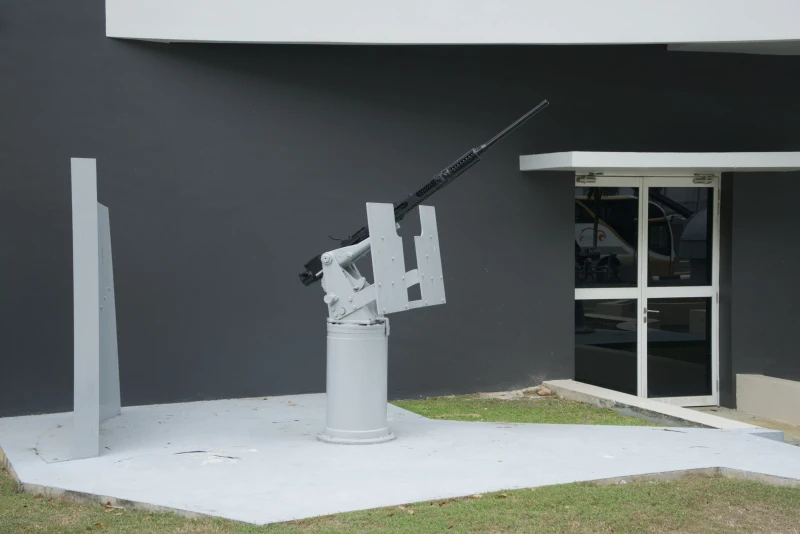
The Swiss-designed Oerlikon 20mm gun was one of the most widely used anti-aircraft cannons during World War II. Like the Bofors 40mm L/60 gun, the Oerlikon was used by navies on both sides of the war such as the United States, Britain, Japan, Germany, and Italy. In the postwar era, the Republic of Singapore Navy (RSN) fitted the Oerlikon on board several ships such as the Independence-class patrol craft, Swift-class coastal patrol craft, the diving support ship RSS Jupiter (M102), and the Navy’s first ship, RSS Panglima. The Oerlikon was sometimes referred to as the Y Gun, as it was often placed at the aft, or rear, of the RSN’s ships. The open-breech air-cooled Oerlikon 20mm was based on the Becker Type M2 20mm cannon, a German autocannon from World War I. An early Oerlikon model was made in the early 1930s, but the British Admiralty and United States Navy (USN) rejected the design due to its low muzzle velocity and poor rate of fire. Coupled with other financial difficulties, this almost caused the Swiss manufacturer to go bankrupt. However, the Imperial Japanese Navy saved the company by purchasing the gun’s license rights, and these funds allowed Oerlikon to make further enhancements to the 20mm cannon. The company improved the gun’s muzzle velocity and rate of fire and, importantly, made it easy to maintain and operate. The Oerlikon 20mm then went on to become one of the most prolific anti-aircraft weapons of World War II. Ironically, these guns on board the USN’s vessels were responsible for downing 32 per cent of Imperial Japanese aircraft from 1941 to 1944. When the Japanese first began their kamikaze attacks on 25 October 1944 during the Battle of Leyte Gulf, the Allied forces quickly realised that the rapid approach speeds of kamikaze aircraft outmatched the Oerlikon’s firepower. The cannons were thus quickly replaced by the Bofors 40mm, with its longer range, increased volume, and higher accuracy.
View object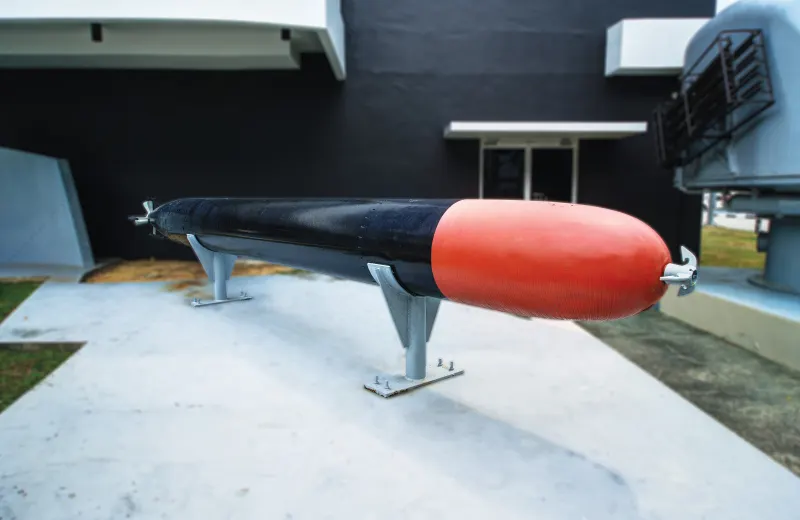
Torpedoes are cigar-shaped underwater missiles with explosive warheads and are propelled either by internal engines or battery-powered electric motors. They are fired from submarines, ships, or aircraft to target surface vessels and submarines. Torpedoes are named after electric rays or torpedo rays that dwell on the seabed and emit electricity as a hunting and defensive mechanism. American inventor Robert Fulton coined the term during the 19th-century Napoleonic Wars when he called his experimental naval mine a torpedo. The Swedish Torpedo 617, or TP 617 torpedo, is used on the Challenger-class and Archer-class submarines of the Republic of Singapore Navy (RSN) and is designed to strike enemy surface ships. Weighing 1,870 kilograms and measuring seven metres long, it is no surprise that the TP 617 is called a heavyweight torpedo. Like most modern torpedoes, it is wire-guided. This means that a thin wire reeling from the torpedo connects it to the submarine’s fire control system. This allows the submarine to transmit commands to the torpedo, controlling its speed and course while it relays its position and depth back to the submarine. The torpedo is also guided by sound signals, such as sonar, to help it identify targets. The TP 617 is an export variant of the TP 613 torpedo, which was designed and manufactured by Swedish defence company Förenade Fabriksverken (now Saab Dynamics AB). The TP 613’s design was based on a British Mark 12 or Fancy torpedo that relied on high-test peroxide, a form of highly concentrated hydrogen peroxide, as a propellant. However, the fuel was known to be unstable. Two British Mark 12 torpedoes exploded on the submarine HMS Sidon on 16 June 1955 before a test-firing session, and the torpedo programme was terminated in 1959. Despite this, the British shared details of their design studies and failure evaluations of the Mark 12 torpedoes with the Swedish Navy. The Navy managed to fix the problems and incorporated the technology into the development of their successful TP 61 torpedo series, which includes the TP 617 torpedoes. Still in use today, the TP 617 is a significant part of the RSN’s past and present submarine capabilities.
View object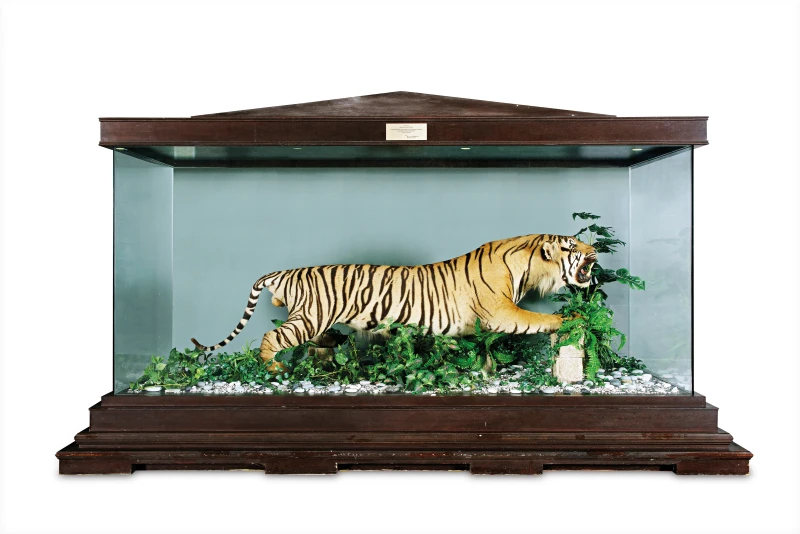
This stuffed tiger was gifted by an Indonesian provincial government to the Republic of Singapore Navy (RSN) in appreciation of the Navy’s contributions to the 2008 iteration of Surya Bhaskara Jaya (SBJ), a humanitarian assistance programme conducted by the Indonesian Navy throughout the Indonesian archipelago. At the invitation of the Indonesian Navy, the RSN has participated in SBJ since 1997. The programme sees the RSN and the Indonesian Navy work together to provide healthcare, educational, and social services, such as performing surgeries and dental checks, carrying out repairs, and distributing essential food items in underdeveloped Indonesian provinces. While military forces are traditionally associated with force and deterrence, the various branches of the Singapore Armed Forces, such as the RSN, help to contribute to the country’s defence diplomacy. Other than SBJ, the RSN’s defence diplomacy efforts include port visits, naval information exchanges, and cooperative exercises with regional and international partners to tackle common maritime security problems in order to reduce tension and build confidence and trust between the RSN and its partners. Gift exchanges between militaries are a common occurrence. Such forms of diplomacy show respect and cultivate relationships between all parties. However, this stuffed tiger is unique among the diplomatic gifts due to its size, special appearance, and meaning. Gifts are typically carefully chosen to honour the recipient and reflect a nation’s essence, people, and culture. This is certainly the case with this gift, as the tiger is an animal that holds significant connotations for both Singapore and Indonesia. Representing strength and courage, the tiger is featured on Singapore’s national coat of arms, or state crest. Tigers also feature prominently in the traditions, cultures, and histories of both commoners and elites on the island of Java. While the villagers deemed tigers as protective ancestral spirits, the elites believed its traits to be wild but necessary to a Javanese ruler in the defence of his kingdom. Although this stuffed tiger was a unique gift, it presented some challenges for the RSN due to Singapore’s domestic law, which regulates the trade of any endangered animal and plant specimens, parts, or products. A permit was also required for its import, and when it was eventually granted, the stuffed tiger became part of the RSN’s collection of diplomatic gifts.
View object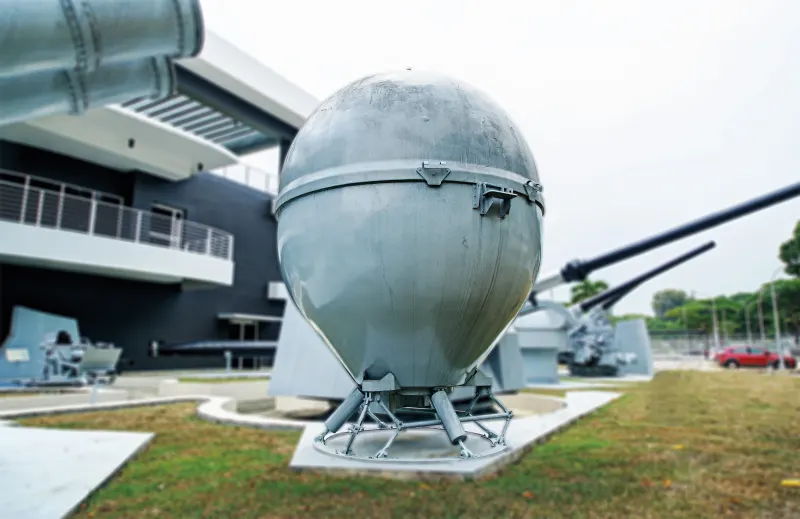
Radars are important navigational tools to help ships navigate and move around safely while avoiding collisions with other ships or their surroundings, especially since sailors cannot rely solely on natural daylight for navigation. This is why radomes are installed on a variety of ships, ranging from small yachts to oil tankers. Radomes are protective structures designed to protect radar antennas, which constantly rotate to acquire signals from sources such as satellites for navigational purposes. The ocean is a tough environment, where strong winds and ocean waves can cause damage to radar antennas. Radomes help protect valuable equipment from environmental factors such as humidity levels, temperature fluctuations, and erosion from rain. Radomes are also used by cruise ships and oil tankers to house equipment that helps them gain access to other forms of data, such as television channels, the Internet, and voice communication. This radome was used on the Republic of Singapore Navy’s (RSN) Sea Wolf-class missile gunboats (MGBs), which are small but lethal warships designed to be mobile fighting vessels. Initially, each MGB had only one radome located on its mast. However, in the 1990s, the RSN decided to upgrade the operational and warfare capabilities of the MGBs with enhancements such as improved electronic warfare features and the Harpoon anti-ship missile, which relies on onboard navigational systems to destroy targets beyond the line of sight. The MGBs’ original navigational radars were replaced by radars with automatic radar plotting aid capabilities that enabled them to track and monitor the movement of radar contacts automatically. These upgrades resulted in the need for additional smaller radomes compatible with the MGBs’ improved capabilities, and these were installed on lower parts of each ship’s mast.
View object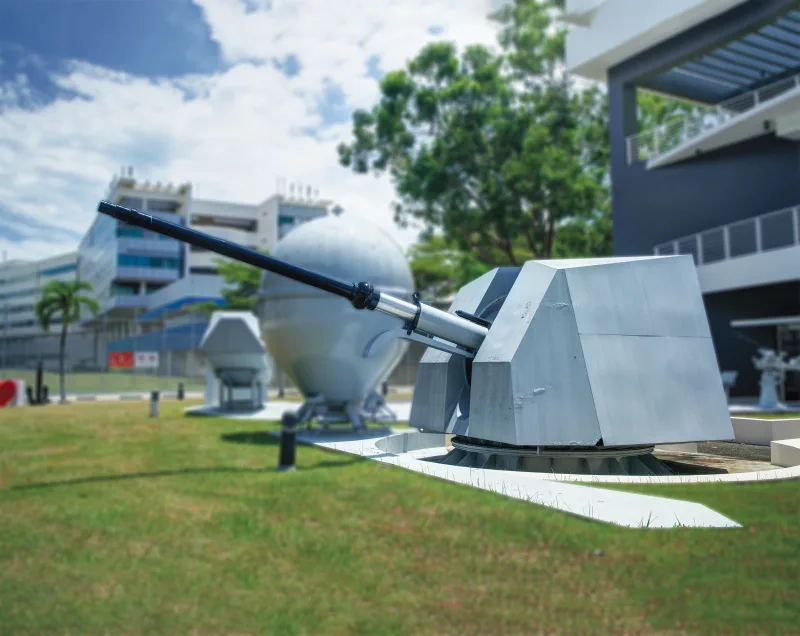
The OTO Melara 76mm Super Rapid gun is a medium calibre point defence autocannon with anti-aircraft and anti-surface capabilities. As a keystone weapon for the Republic of Singapore Navy, this gun has been fitted on board several ships such as Victory-class missile corvettes, Fearless-class patrol vessels, Endurance-class tank landing ships, Formidable-class frigates, and Independence-class littoral mission vessels. The Super Rapid variant was designed by Italian defence manufacturer OTO Melara and is one of the few medium calibre naval guns with the capability of sustained fire. Compared to its predecessor, the OTO Melara Compact, the Super Rapid was produced with enhanced accuracy and a higher rate of fire to excel in anti-ship missile defence. This was achieved by modifying the ammunition feed and fusing. The autocannon’s magazine is independent of its turret, allowing its feed to be interrupted to insert various types of ammunition. This enhances the gun’s adaptability when engaging multiple targets. As a long-range multi-role gun, the Super Rapid is one of the most popular naval guns today and is used by approximately 60 navies around the world.
View object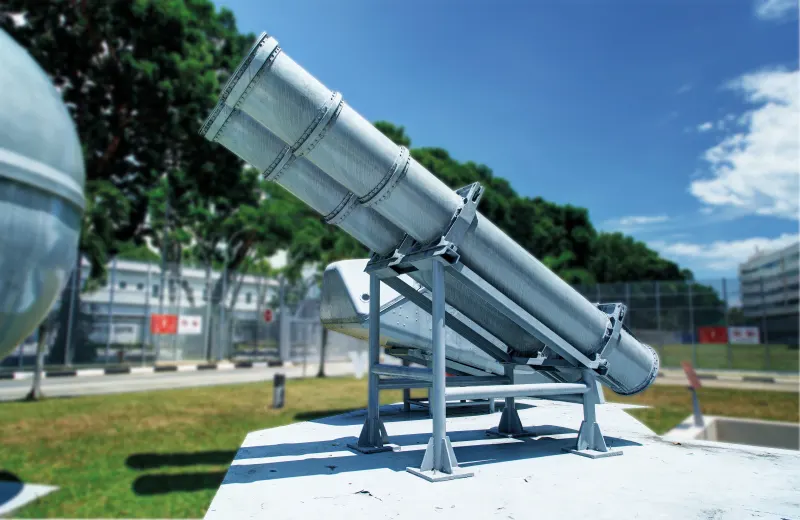
The Harpoon missile, named after a spear and used to hunt whales and other large sea creatures, originated from a 1960s United States Navy (USN) programme to develop anti-ship missiles to target “whales” (naval slang for submarines). However, the sinking of the Israeli destroyer INS Eilat by Soviet Styx anti-ship missiles fired from Egyptian missile boats during the 1967 War of Attrition made the USN recognise the need for a dedicated anti-ship missile system. As a result, the original Harpoon project with defence contractor McDonnell Douglas (now known as Boeing Defense, Space & Security) was repurposed in the 1970s as an all-weather anti-ship missile system. This launcher would have carried 4.75-metre-long Harpoon missiles that each weighed 681 kilogrammes, making both the Harpoon launcher and its missiles bulky objects. The missile’s weight allowed for a significant amount of firepower from each missile, while other features enhanced the Harpoon’s accuracy and range. Designed for over-the-horizon engagements or when targets are beyond the line of sight, the Harpoon missile relies on onboard guidance systems and active radar seekers to narrow down its targets. The Harpoon missile came to the attention of the Republic of Singapore Navy (RSN) in the late 1970s due to concerns that the Gabriel missile’s shorter radar horizon range or line of sight from the radar to the horizon was a significant limitation. This became more pronounced when another regional Southeast Asian navy acquired a longer-range active homing missile with advanced fire control radar systems, which had more advantages over the Gabriel missile. Due to these factors, the RSN decided to order the Harpoon missiles to replace or complement the Gabriel missiles on the Navy’s missile gunboats and missile corvettes.
View object